


Skip to Content
  • Delivery in 4–10 working days across Saudi Arabia
  • A tax invoice with every order
  • Technical support before and after you buy

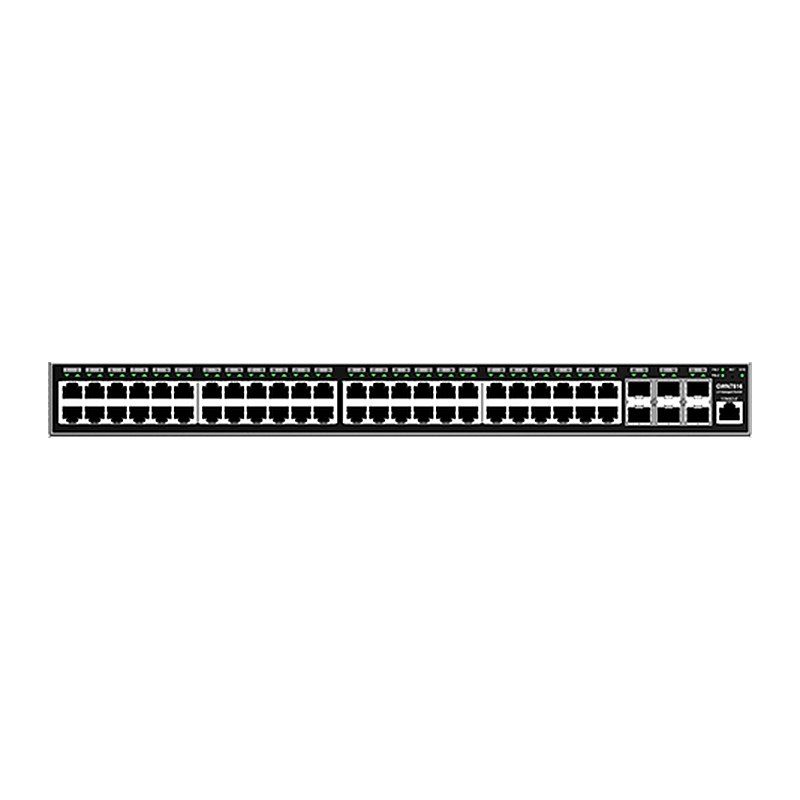
Grandstream GWN7816 Layer 3 Managed Switch, 48x Gigabit Ethernet, 6x 10G SFP+, Hot-Swap PSU

Part number GWN7816
  • 48 Gigabit Ethernet ports and 6 10 Gigabit SFP+ ports with up to 216 Gbps switching capacity
  • Layer 3 static and dynamic routing (RIP, RIPng, OSPF, OSPFv3, BGP) in IPv6 and IPv4 networks
  • Reliability features including fault detection, device protection, dual boot, dual system file redundancy, link aggregation and storm control
  • Hot-swappable PSU support (RPS-70W, purchased separately) for 1+1 power redundancy
  • ARP Inspection, IP Source Guard, DoS protection, port security & DHCP snooping
  • Built-in QoS and support for stacking of up to 4 switches with redundant backup
  • Management via embedded controller, CLI, GDMS Networking, GWN Manager and GWN Series Routers
Price
⃁ 1,989.84 ⃁ 1,989.84 ⃁ 2,590.94 Save 23%
⃁ 1,989.84 ⃁ 2,590.94
(Tax excluded)
  • Delivery within 4–10 business days across Saudi Arabia
  • Warranty according to the manufacturer
  • Tax invoice with every order
  • Technical support before and after purchase

Not sure this model fits your setup? Read the buying guide
Overview of Grandstream GWN7816

The Grandstream GWN7816 is a 48-port enterprise Layer 3 managed network switch for medium-to-large businesses that need scalable, secure and high-performance networks with maximum capacity and control. It offers 48 Gigabit Ethernet ports, 6 10G SFP+ ports and 216 Gbps switching capacity. A second hot-swappable RPS-70W power supply can be added for 1+1 redundancy. Static and dynamic routing, advanced VLANs, QoS, IGMP/MLD Snooping, dual boot and comprehensive security are built in. Manage it via web UI, CLI, GDMS Networking, GWN Manager or GWN routers in large offices, hotels, hospitals, campuses and warehouses.

Technical Specifications – Grandstream GWN7816

General

Network ProtocolsIPv4, IPv6, IEEE 802.3, IEEE 802.3i, IEEE 802.3u, IEEE 802.3ab, IEEE 802.3z, IEEE 802.3ae, IEEE 802.3az, IEEE 802.3ad, IEEE 802.3x, IEEE 802.1p, IEEE 802.1Q, IEEE 802.1d, IEEE 802.1s, IEEE 802.1w, IEEE 802.1x

Ports

Gigabit Ports48
10G SFP+ Ports6 (supports DAC cable, must be ≤ 5 m)
Maximum No. of Supported ModulesSM-10G: 6; MM-10G: 6; RJ45-10G: 3 (RJ45-10G modules must be interval inserted)
Console1
Auxiliary Ports1 × Reset Pinhole

Power & PoE

PSUs1 PSU of 70W by default, supports 1 hot-swap PSU (purchased separately)
Hot-Swappable PSURPS-70W – available for separate purchase
Surge Protection±4 kV CM and ±2 kV DM for power; ±4 kV CM for network ports
ESD±12 kV for contact discharge

Performance

Forwarding ModeStore-and-forward
Total Non-Blocking Throughput108 Gbps
Switching Capability216 Gbps
Forwarding Rate160.704 Mpps
Packet Buffer16Mb
Network Latency<4 µs

Software Features

Switching32K MAC addresses, including static, dynamic, filtering and sticky MAC address; 4K VLANs, port-based VLAN, IEEE 802.1Q VLAN tagging, MAC-based VLAN, protocol-based VLAN, QinQ; Private VLAN; Voice VLAN including auto voice VLAN, tagged OUI and untagged OUI; 32 VLAN virtual interface with 9216 MTU; 2K ARP/NDP; GVRP (pending); 32 link aggregation; Spanning tree, 64 instances for STP/RTSP/MSTP/PVST(+)/RPVST(+); ERPS (pending)
Routing12K (IPv4)/4K (IPv6) routes; 32 (IPv4)/32 (IPv6) static routing; Policy routing (pending); Dynamic routing, including RIP, RIPng, OSPF, OSPFv3 and BGP; Routing Policy; VRRP (pending)
MulticastIGMP Snooping with IGMPv2 and IGMPv3, 256 IGMP Snooping groups; MLD Snooping with MLDv1 and MLDv2, 256 MLD Snooping groups; MVR
QoS/ACLPort priority; Priority mapping; Queue scheduling, including SP, WRR, WFQ, SP-WRR and SP-WFQ; Traffic shaping; Rate limit; 4K ACL for Ethernet, IPv4 and IPv6
DHCPDHCP server, DHCP relay, DHCP Option 82, 60, 160 and 43
MaintenanceCPU and memory monitoring; Fault detection and alarm for power supply and fan; SNMP including SNMPv1, SNMPv2c, SNMPv3; RMON; LLDP & LLDP-MED; Backup and restore; Syslog; Diagnostics including Ping, Traceroute, Mirroring including SPAN and RSPAN, UDLD (pending) and copper test; Upgrade via FTPS / TFTP / HTTP / HTTPS or local upload, mass provisioning using DHCP Option / TR-069 (pending) / GDMS Networking / GWN Manager / GWN router
SecurityUser hierarchical management and password protection, HTTPS, SSH, Telnet; Identity authentication including 802.1X authentication and MAC authentication; AAA authentication including RADIUS, TACACS+; Storm control; Port isolation, port security, sticky MAC; Filtering MAC address; IP/IPv6 source guard, DoS attack prevention, ARP inspection; DHCP/DHCPv6 Snooping; Loop protection including BPDU protection, root protection and loopback protection; Kensington Security Slot (Kensington Lock) support

Physical & Environmental

MountingDesktop, or Rack-Mount (rack-mounting kits included)
LEDs1x tri-color LED for device tracking and status indication; 2x bi-color LEDs for per power supply PSU1/2; 54x green-color LEDs for data transferring
Fan4
EnvironmentalOperating: 0 °C to 45 °C, humidity 10–90% RH non-condensing; Storage: -10 °C to 60 °C, humidity 10–90% RH non-condensing
Dimensions440mm (L) × 300mm (W) × 44mm (H)
Unit Weight4.7 kg
Package Content1x Switch; 1x 1.2m AC Cable; 1x 25cm Ground Cable; 4x Rubber Footpads; 2x Front Rack-Mounting Kits; 8x Screws (KM 3*6); 1x Simplified Quick Installation Guide; 1x Regulatory Paper
ComplianceFCC, CE, RCM, IC, UKCA

Source: Grandstream official website and datasheet. Specifications are subject to change by the manufacturer.

PRACTICAL ANSWERS

Network planning questions

Should I choose a router, a switch or an access point?

Start with the task: connecting networks, adding wired device ports, or providing wireless coverage. A single installation may need more than one device type. Share a site diagram and device list so the proposed roles and connections are clear.

Why is wireless coverage weak in some rooms?

Check the access point location, building layout, obstacles and the number of active devices. Measure coverage where people actually work before choosing extra equipment; changing the internet package alone may not address a coverage problem.

How do I select a switch for powered network devices?

List the devices to be connected and check each device’s power requirements against the switch’s per-port capability and total documented power budget. Also review uplink capacity and reserve ports for the expansion you actually expect.

Can the guest network be separated from business devices?

Define which devices and services guests should be able to reach, then check whether the router, switch and access points support the required separation. Test the resulting access rules; a different wireless network name alone is not the acceptance test.

What information helps plan a network upgrade?

Provide floor plans, current equipment models, internet connections, cabling details and peak device counts. Describe the applications that matter most and the observed problem, such as disconnections or slow local file access.

How should network performance be checked after installation?

Agree on the locations and representative workloads to test, then record wired and wireless results separately. Check connectivity, coverage and access rules during normal use, and retain a diagram and configuration backup for support.