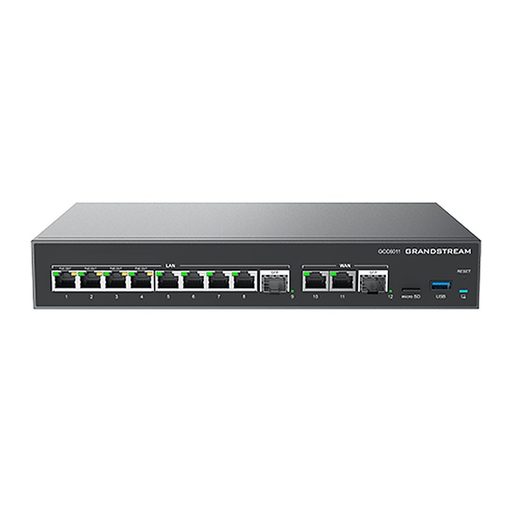
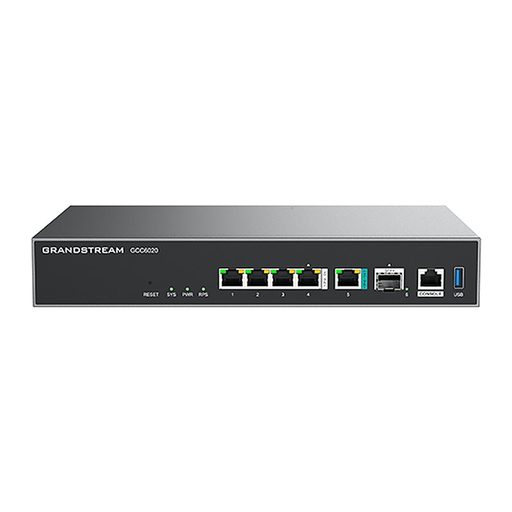
Overview of Grandstream GCC6010W
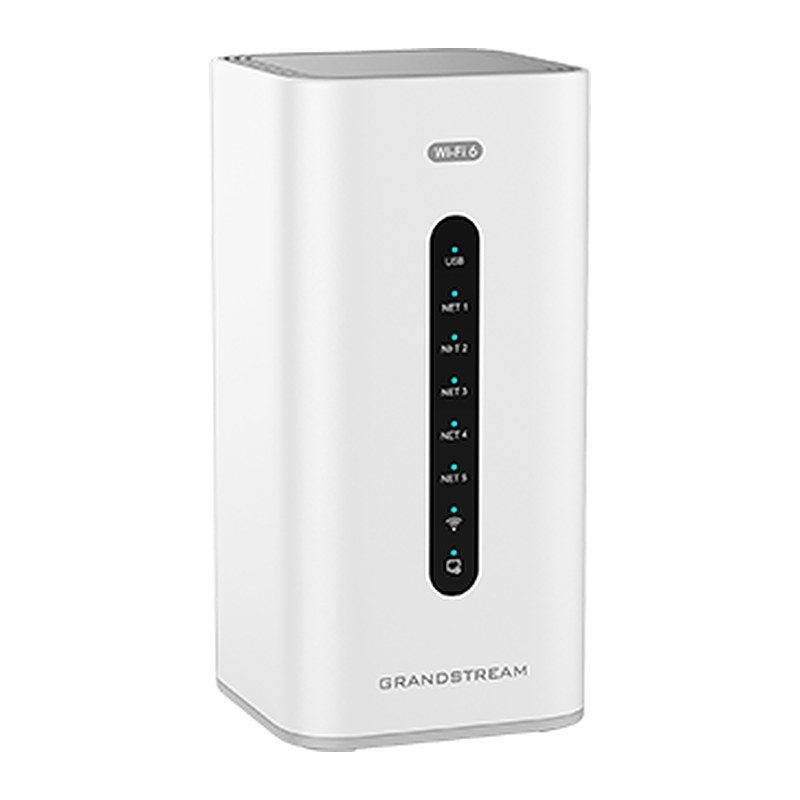
The Grandstream GCC6010W is a UC + networking convergence device that combines a VPN router, a next-generation firewall, an IP PBX and a dual-band Wi-Fi 6 access point in one compact desktop unit. It offers 5 Gigabit Ethernet ports (WAN/LAN configurable, up to 3 WAN), 3 Gbps routing, 1 Gbps IPsec VPN throughput and wireless features such as captive portals, virtual access points and wireless intrusion detection. The built-in PBX supports 24 users and 8 concurrent calls by default, with upgrades available. Managed via GDMS cloud, mobile app, web UI, SSH or SNMP, it suits small offices, clinics, cafés and retail shops.
Technical Specifications – Grandstream GCC6010W
Hardware
| CPU | Quad-core CA53, 2.0 GHz |
|---|
Wi-Fi
| Wi-Fi Standards | IEEE 802.11 a/b/g/n/ac/ax |
|---|
| Antennas | 3 individual internal antennas (2 × dual-band + 1 × single-band 5 GHz); 2.4 GHz: maximum gain 4 dBi; 5 GHz: maximum gain 6 dBi |
|---|
| Wi-Fi Data Rates (2.4 GHz) | IEEE 802.11ax: 7.3 Mbps to 573.5 Mbps; IEEE 802.11n: 6.5 Mbps to 300 Mbps; IEEE 802.11b: 1, 2, 5.5, 11 Mbps; IEEE 802.11g: 6, 9, 12, 18, 24, 36, 48, 54 Mbps |
|---|
| Wi-Fi Data Rates (5 GHz) | IEEE 802.11ax: 7.3 Mbps to 3,603 Mbps; IEEE 802.11ac: 6.5 Mbps to 2,600 Mbps; IEEE 802.11n: 6.5 Mbps to 450 Mbps; IEEE 802.11a: 6, 9, 12, 18, 24, 36, 48, 54 Mbps |
|---|
| Frequency Bands | 2.4 GHz radio: 2,400–2,483.5 MHz; 5 GHz radio: 5,150–5,895 MHz (not all frequency bands can be used in all regions) |
|---|
| Channel Bandwidth | 2.4 GHz: 20 and 40 MHz; 5 GHz: 20, 40, 80, 160 MHz |
|---|
| Wi-Fi and System Security | WPA/WPA2-PSK, WPA/WPA2 Enterprise (TKIP/AES); WPA3, anti-hacking secure boot and critical data/control lockdown via digital signatures, unique security certificate and random default password per device |
|---|
| MU-MIMO | 2.4 GHz: 2×2:2; 5 GHz: 3×3:3 |
|---|
| Coverage Range | Up to 175 m (574.15 ft) in open areas; recommended usable area is no more than 180 m² |
|---|
| Maximum TX Power | 2.4 GHz: 28.5 dBm; 5 GHz: 25.5 dBm (varies by country, frequency band, and MCS rate) |
|---|
| Receiver Sensitivity | 2.4 GHz: 802.11b -97 dBm@1 Mbps; 802.11g -93 dBm@6 Mbps; 802.11ax 20 MHz -64 dBm@MCS11. 5 GHz: 802.11a -93 dBm@6 Mbps; 802.11ac 80 MHz -62 dBm@MCS9; 802.11ax 160 MHz -54 dBm@MCS11 |
|---|
Hardware
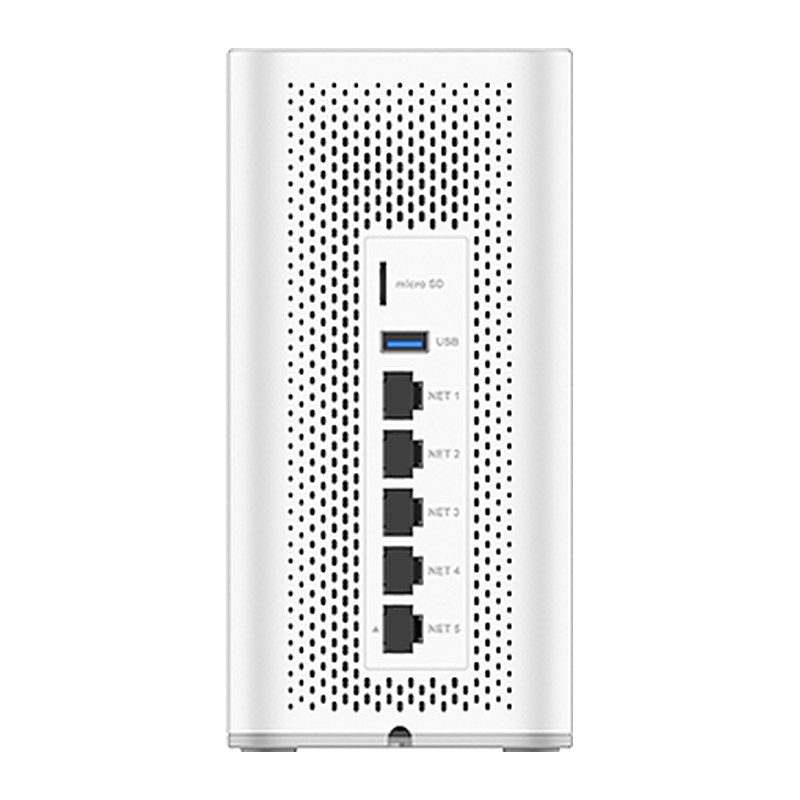
| Network Ports | 5 × Gigabit Ethernet ports; all ports are WAN/LAN configurable, max 3 WAN ports |
|---|
| Auxiliary Ports | 1 × Micro-SD, 1 × USB 3.0, 1 × Reset button |
|---|
| Memory | 2 GB RAM, 32 GB eMMC Flash |
|---|
| LEDs | 8 × LEDs for device tracking and status indication |
|---|
Performance
| Router | 3 Gbps |
|---|
| IPsec VPN Throughput | 1 Gbps |
|---|
| NAT Sessions | 160K |
|---|
| IDS/IPS | 900 Mbps |
|---|
| PBX | 24 users and 8 concurrent calls by default; upgrades available for purchase |
|---|
Networking & Security
| Connection Type | DHCP, Static IP, PPPoE |
|---|
| Network Protocols | IPv4, IPv6, IEEE 802.1q, IEEE 802.1p, IEEE 802.1x, IEEE 802.3, IEEE 802.3u, IEEE 802.3x, IEEE 802.3ab |
|---|
| QoS | VLAN, TOS; multiple traffic classes, filter by port, IP address, DSCP, and policing; App QoS: application/protocol monitoring and traffic statistics; VoIP Prioritization |
|---|
| Firewall | DDNS, Port Forwarding, DMZ, UPnP, DoS & Spoofing defense, traffic rules, NAT, ALG; DPI, Anti-Virus, IPS/IDS, SSL Proxy; Content Control: DNS filtering, web URL/class/keyword filtering, application identification and control |
|---|
| IPsec VPN | Client-to-Site / Site-to-Site; Encryption: 3DES, AES; Authentication: MD5, SHA-1, SHA2-256; Key Exchange: Main/Aggressive Mode, Pre-shared Key, DH Groups 1/2/5/14; Protocols: ESP; NAT Traversal |
|---|
| PPTP / L2TP VPN | PPTP VPN Server / Client; PPTP Encryption: MPPE 40-bit, 128-bit; PPTP/L2TP Authentication: MS-CHAPv1/2; L2TP Client-to-Site |
|---|
| OpenVPN® / WireGuard® | OpenVPN® Server / Client; Encryption: AES, DES; Authentication: MD5, SHA-1, SHA2-256, SHA2-384, SHA2-512; Certificate: RSA; WireGuard® |
|---|
Management
| Network Management | Grandstream Device Management System (GDMS), Local Web GUI, SSH, and SNMP (v1/v2c/v3) |
|---|
| Max AP/Clients | Up to 150 GWN APs; Up to 500 Clients |
|---|
Power & Environment
| Power | Universal power adapter included: Input 100–240 V AC, 50–60 Hz; Output 12 V DC, 1.5 A (18 W) |
|---|
| Operating Temperature | 0 °C to 45 °C (32 °F to 113 °F) |
|---|
| Storage Temperature | -30 °C to 60 °C (-22 °F to 140 °F) |
|---|
| Storage Humidity | 5%–95%, non-condensing |
|---|
Physical
| Mounting | Desktop |
|---|
| Material | Plastic |
|---|
| Unit Dimension | 95 mm × 95 mm × 193 mm (3.74″ × 3.74″ × 7.60″) |
|---|
| Unit Weight | 565 g (1.25 lb) |
|---|
| Package Dimension | 186 mm × 127 mm × 105 mm (7.32″ × 5.00″ × 4.13″) |
|---|
| Package Weight | 920 g (2.03 lb) |
|---|
| Package Content | GCC6010W, Universal Power Supply, Network Cable, Quick Installation Guide |
|---|
| Compliance | FCC, CE, RCM, IC |
|---|
Source: Grandstream official website and datasheet. Specifications are subject to change by the manufacturer.