








In warehouses, factories and car parks, network equipment often sits outside air-conditioned offices: in an enclosure on a pole or wall, with high heat, dust and vibration. An ordinary office switch in these conditions stops or fails before long. In this guide the Rasid team explains what makes a switch industrial and when it is the right choice.
1. Warehouse conditions
Warehouses in Riyadh and the Eastern Province can get very hot in summer, especially under metal roofs, are dusty, and have forklifts passing near columns and cables. Distances between cameras, access points and the main rack are often long, so switches have to be distributed inside the warehouse itself.
2. What makes a switch industrial?
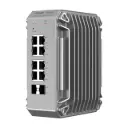
- A wide operating temperature range, from -40 to 75 °C on many models.
- A fanless metal housing that does not pull dust inside.
- DIN-rail mounting inside an electrical enclosure.
- Two power inputs for two power sources, with surge protection on the ports.
- Fibre ports to link to the main rack over long distances.
3. Power supply
Many industrial switches run on DC, usually between 48 and 57 V when PoE is used, so they need an industrial DIN-rail power supply sized for the PoE budget with a safety margin. We calculate the budget the same way as in our PoE switch selection guide.
4. Fibre and ring networks
Distributed switches connect to the main rack over fibre to go beyond the 100 m limit and avoid electrical interference. On large sites we connect the switches in a ring with a fast recovery protocol, so if a cable is cut at one point, traffic switches to the other direction within moments and the cameras keep running.
Choosing fibre and modules is covered in our guide to linking two buildings.
5. The enclosure and its location
The switch goes in an enclosure with the required protection rating, in a shaded spot where possible and away from forklift paths, with dust-protected vents when needed. Cables are fixed firmly inside the enclosure, the enclosure and switch are earthed, and surge protection is fitted on outdoor cables.
6. When is an ordinary switch enough?
If the switch sits in a rack in an air-conditioned room or in the warehouse office, a good ordinary switch is enough. If it sits in an enclosure on a pole, under a metal roof without cooling, or near equipment that causes vibration or interference, the industrial switch is the safe choice.
Browse industrial switches, and read about heat and dust in our guide to CCTV in Riyadh heat and dust.
7. Maintenance
Even an industrial switch needs regular checks: enclosure cleanliness, door seals and cable glands, the power supply and surge protection, port errors and the ring status. This can be included in the site's annual maintenance contract together with the rest of the network and cameras.
Frequently asked questions
Can an ordinary switch go inside an enclosure with a fan?
It may work in mild locations, but the fan pulls in dust and the outside air is already hot, which shortens the switch's life. An industrial switch is designed for these conditions from the start.
Do industrial switches need special power?
They usually run on DC from an industrial DIN-rail power supply, and two power sources are preferred on important sites so the switch keeps running if one fails.
Need installation or maintenance?
Rasid's team works out of Riyadh and travels for supply, installation, programming and maintenance in Riyadh, Dammam, Khobar, Jeddah and across the Eastern Province, with annual maintenance contracts for businesses and homes. Message us on WhatsApp +966559790746 or request a solution for your project.