
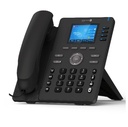


Staff who move around a warehouse, factory or hotel cannot stay next to a desk phone. The answer is a cordless phone that registers to the PBX and carries their extension wherever they go. Grandstream offers two ways to do it: a DECT system with a base station and handsets, or Wi-Fi phones that run on your wireless network. This guide compares the two and helps you choose.
1. How a DECT system works
A DECT base station connects to the network with a single cable and runs on PoE, and the handsets link to it wirelessly on a band reserved for cordless phones, away from Wi-Fi congestion. The DP750 or DP752 base supports up to 5 handsets, 10 SIP accounts and 5 concurrent calls, while the DP755 supports up to 10 handsets and 20 SIP accounts.
Range reaches 50 m indoors and up to 400 m in open areas with the DP752 or DP755 base and newer handsets such as the DP730. If you need more coverage, the DP760 repeater adds 300 m outdoors and 50 m indoors, and up to 5 repeaters can be used.
2. Pick the handset for the job
- DP720: an essential handset with a 1.8-inch colour screen and 20 hours of talk time.
- DP722: adds push-to-talk and one-touch door opening with GDS devices.
- DP725: a battery that gives 50 hours of talk time, and a 10-minute charge gives up to 4 hours.
- DP730: a 2.4-inch screen and 40 hours of talk time, with proximity and motion sensors.
- DP735: a rugged handset rated IP67 against water and dust, drop-safe from 2.5 m with 65 hours of talk time, suited to warehouses and factories.
3. WP series Wi-Fi phones
If you already have Wi-Fi that covers the site well, WP phones run on it directly with no dedicated base, and most models support 802.11k/r/v fast roaming between access points. The range starts with the two-line WP810 and includes the WP826 with Wi-Fi 6 and a 3000 mAh battery for 12 hours of talk time.
The WP836 is a rugged phone rated IP67 and IP69K, with alarm functions such as an emergency button and man-down and no-movement alerts. The WP856 runs Android 13 with a 5.5-inch touch screen and a built-in barcode scanner, suited to warehouse and retail teams that need calls and scanning in one device.
4. DECT or Wi-Fi?
| Criterion | DECT | Wi-Fi (WP series) |
|---|---|---|
| Infrastructure | A DECT base, plus repeaters if needed | Wi-Fi covering the whole site |
| Battery life | Up to 65 hours of talk time (DP735) | Up to 20 hours of talk time (WP856) |
| Handsets | Up to 10 handsets per DP755 base | Depends on Wi-Fi capacity |
| Best for | Offices, warehouses and wide sites | Sites with strong Wi-Fi and app-based work |
Tip: before choosing Wi-Fi phones, get a coverage survey, because call quality depends on signal strength in every corner staff walk through.
To plan the Wi-Fi network, see our guide to Grandstream GWN access points.
Products mentioned in this guide
- Grandstream DP755 – DECT base for 10 handsets and 20 SIP accounts, PoE
- Grandstream DP730 – DECT handset with a 2.4-inch screen and push-to-talk
- Grandstream DP735 – Rugged IP67 DECT handset with 65 hours of talk time
- Grandstream DP760 – DECT repeater adding 300 m outdoors and 50 m indoors
- Grandstream WP826 – Wi-Fi 6 phone with 3 SIP accounts and 12 hours of talk time
- Grandstream WP836 – Rugged IP67/IP69K Wi-Fi 6 phone with alarm functions
- Grandstream WP856 – Android handset with barcode scanner, Wi-Fi 6 and IP65
Frequently asked questions
Do the DECT phones work with a UCM PBX?
Yes. DP base stations support automatic provisioning with UCM PBXs, and they also work with any SIP PBX.
Can the handsets be used like walkie-talkies?
Yes. Models such as the DP722, DP730 and DP735 and the WP phones support push-to-talk for instant calls.
What is the difference between the DP752 and the DP755?
Both reach up to 400 m outdoors with the newer handsets, but the DP752 supports 5 handsets and 10 SIP accounts, while the DP755 supports 10 handsets and 20 accounts.
Need help choosing the right Grandstream solution?
Rasid's team in Riyadh helps you choose the right equipment for your site and handles supply, installation and programming for businesses, hotels and homes in Saudi Arabia. Message us on WhatsApp +966559790746 or request a solution for your project.