


In a monitoring room or a shop you often need the same picture on more than one screen: one at the manager's desk, another at the till and a third at the entrance. An HDMI splitter takes one HDMI output and sends it to several screens at once. DTECH offers splitters with two, four and eight outputs, and this guide explains how to choose.
1. Splitter or switcher?
A splitter sends one source to several screens, a switcher picks between several sources for one screen, and a matrix routes several sources to several screens. The DTECH products here are splitters: one input and several outputs.
2. The models
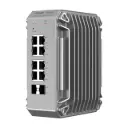
- DT-7142A: one HDMI input and two outputs, up to 4K×2K, with 3D and HDCP support in a metal enclosure.
- DT-7144A: one input and four outputs, up to 4K×2K at 30 Hz, compatible with 1080p and 3D, with an LED per output, and cascadable with other splitters, matrices and extenders.
- DT-7148B: one input and eight outputs, up to 4K×2K.
3. What 4K at 30 Hz means
The DT-7144A reaches 4K at 30 frames per second, which is enough for cameras, information boards and adverts. Very fast motion such as gaming needs a higher refresh rate. If your screens are 1080p, the splitter is compatible with them.
4. Reaching distant screens
A splitter outputs ordinary HDMI, so if one screen is far away, add an HDMI extender after its output, such as the DT-7009C up to 50 m or the DT-7043 up to 150 m. The DT-7144A explicitly supports cascading with extenders and other splitters.
5. Installation tips
- If the screens differ in resolution, set the recorder output to one they all support, such as 1080p.
- Use short, good-quality HDMI cables between the splitter and nearby screens.
- HDCP-protected content needs a splitter that supports it, such as the DT-7142A.
- If no picture appears at start-up, try restarting in order: screens, then splitter, then source.
To show eight screens from one recorder, the DT-7148B is enough; if you want a different picture on each screen, that is a job for the recorder's multiple outputs or a video wall controller, not a splitter.
The comparison at a glance
| Model | Outputs | Resolution | Highlight |
|---|---|---|---|
| DTECH DT-7142A | 2 | 4K×2K | 3D, HDCP, metal case |
| DTECH DT-7144A | 4 | 4K×2K at 30 Hz | LEDs and cascading |
| DTECH DT-7148B | 8 | 4K×2K | Eight screens from one source |
For distant screens, see our guide to DTECH HDMI extenders.
For screens in shops and restaurants, see our guide to HDMI distribution in shops and restaurants.
Products mentioned in this guide
- DTECH DT-7142A – 4K HDMI splitter, two screens
- DTECH DT-7144A – 4K HDMI splitter, four screens
- DTECH DT-7148B – 4K HDMI splitter, eight screens
- DTECH DT-7009C – HDMI extender up to 50 m
- DTECH DT-7043 – HDMI over IP extender up to 150 m
Frequently asked questions
Can a splitter show different pictures on each screen?
No, it shows the same picture on every screen.
Does a splitter reduce picture quality?
It does not change the resolution if the screens support it, and these splitters handle up to 4K×2K.
Can two splitters be chained?
The DT-7144A lists cascading with other splitters, matrices and extenders.
Need help choosing the right DTECH solution?
Rasid's team in Riyadh helps you choose the right equipment for your site and handles supply, installation and programming for businesses, hotels and homes in Saudi Arabia. Message us on WhatsApp +966559790746 or request a solution for your project.