


A direct extender links a source to a screen over a dedicated cable. An HDMI over IP extender turns the picture into network data that can pass through switches and reach more than one place. DTECH offers two extenders of this kind, and this guide explains how they work, when you need them and how to prepare the network.
1. How it differs from a direct extender
With a direct extender the cable belongs to the sender and receiver alone. With an IP extender the sender sends the picture as data packets, so the cable can run through a switch, and on some models more than one receiver can get the same picture. That makes it suitable for distributing video around a building.
2. DT-7043: HDMI video up to 150 m
A sender and receiver kit that carries 1080p at 60 Hz over Cat5 or Cat6 up to 150 m as rated by the supplier, with IR return, and can pass through network switches. It suits distant screens for recording systems in control rooms, malls and offices.
3. DT-7050: video plus keyboard and mouse
The DT-7050 adds USB keyboard and mouse control to 1080p at 60 Hz, up to 120 m on Cat5e or Cat6, with IR return. It works point-to-point or point-to-multipoint through switches and routers, which suits operating a recorder remotely from a control room.
4. Network tips
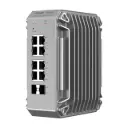
- Use a Gigabit switch for IP extenders, since video streams need a lot of bandwidth.
- Keep extender traffic apart from the staff network with a dedicated switch or VLAN so neither slows the other.
- Do not send extender streams over the internet or Wi-Fi; they are designed for cable inside the building.
- Label the switch ports used by the extenders clearly in the network map.
5. When to choose IP
- The distance between source and screen is more than 50 m.
- The cable runs through patch panels and switches already in the building.
- You want video and control at more than one point, as with the point-to-multipoint DT-7050.
If the screen is close and the cable runs directly, a direct extender such as the DT-7009C is simpler and costs less.
IR return means you use the source device's remote at the distant screen: point the remote at the receiver end, and the signal reaches the device in the other room.
The comparison at a glance
| Model | Distance | What it carries | Topology |
|---|---|---|---|
| DTECH DT-7043 | 150 m | 1080p 60 Hz video | Through switches |
| DTECH DT-7050 | 120 m | 1080p video plus USB | Point-to-point or multipoint |
For simpler direct extenders, see our guide to DTECH HDMI extenders.
Products mentioned in this guide
- DTECH DT-7043 – HDMI over IP extender up to 150 m
- DTECH DT-7050 – IP KVM extender up to 120 m
- DTECH DT-7009C – Direct HDMI extender up to 50 m
Frequently asked questions
Can an IP extender use the existing network switch?
The supplier states they can pass through switches, but a Gigabit switch or dedicated VLAN is best so video does not crowd out staff traffic.
What is IR return for?
You control the source device with its remote from the distant screen.
Does the DT-7043 carry keyboard and mouse?
No, it carries video with IR return; for keyboard and mouse you need the DT-7050.
Need help choosing the right DTECH solution?
Rasid's team in Riyadh helps you choose the right equipment for your site and handles supply, installation and programming for businesses, hotels and homes in Saudi Arabia. Message us on WhatsApp +966559790746 or request a solution for your project.