
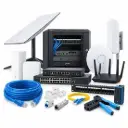


Most HDMI extender problems, such as a choppy picture or a black screen, come from the cable, not the device. The distance on the box is a maximum, reached only with good cable and a proper installation. This guide explains how to run cable for DTECH extenders to get the best picture over the full distance.
1. Cat6 or Cat5e?
DTECH extenders work on Cat5e and Cat6, but some rate their distance on Cat6 specifically: the DT-7073 reaches 50 m on Cat6 and also works on Cat5 and Cat5e. So use Cat6 for new runs, especially when the distance approaches the maximum.
2. Solid copper, not CCA
Some cheap cables are copper-clad aluminium (CCA), whose higher resistance weakens both signal and power over long runs. That matters even more with the DT-7073, which carries power over the cable. Choose solid copper cable from a trusted source.
3. A direct run without joints
With direct extenders such as the DT-7009C, DT-7073 and DT-7054, the cable should ideally be one piece from sender to receiver, without patch panels, couplers or switches along the way, since every joint weakens the signal. IP extenders such as the DT-7043 and DT-7050 can pass through switches.
4. Keep away from power cables
Do not run network cable alongside power cables over long distances, and where they cross, make it at a right angle. In industrial areas or near motors, use shielded (STP) cable with proper earthing.
5. Ends and testing
- Terminate both ends in the same order, such as T568B, with connectors that match the cable type.
- Test the cable with a tester before connecting the extender; one broken wire can cause a choppy picture.
- Leave a little slack at each end, but do not coil large amounts of spare cable.
- Connect the sender to the source with a short, good HDMI cable.
Static electricity can damage ports when plugging in; the DT-7054 has built-in ESD protection, but it is still best to connect cables with the devices switched off.
Cable and distance by extender
| Extender | Cable | Max distance | Path |
|---|---|---|---|
| DTECH DT-7009C | Cat5e or Cat6 | 50 m | Direct |
| DTECH DT-7073 | Cat6, also Cat5/5e | 50 m on Cat6 | Direct with power |
| DTECH DT-7054 | Network cable | 50 m | Direct |
| DTECH DT-7043 | Cat5 or Cat6 | 150 m | Through switches |
| DTECH DT-7050 | Cat5e or Cat6 | 120 m | Through switches and routers |
If a problem appears after installation, see our guide to troubleshooting HDMI extenders and splitters.
Products mentioned in this guide
- DTECH DT-7009C – HDMI extender over Cat5e or Cat6
- DTECH DT-7073 – HDMI extender with power over Cat6
- DTECH DT-7054 – KVM extender with ESD protection
- DTECH DT-7043 – HDMI over IP extender
- DTECH DT-7050 – IP KVM extender
Frequently asked questions
Should I use shielded Cat6?
Ordinary UTP is usually enough; use shielded STP in noisy environments, with proper earthing.
Can a direct extender pass through a patch panel?
It usually works, but every joint reduces the possible distance, so a direct run is best.
Why is the picture choppy even below the maximum distance?
Usually a CCA cable, a poorly made termination or a cable next to power lines; check the cable first.
Need help choosing the right DTECH solution?
Rasid's team in Riyadh helps you choose the right equipment for your site and handles supply, installation and programming for businesses, hotels and homes in Saudi Arabia. Message us on WhatsApp +966559790746 or request a solution for your project.