




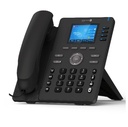


An IP phone is a device on the company network, and if it is left unprotected, calls can be intercepted or an unknown device can be plugged into a desk port. Alcatel-Lucent lists TLS, SRTP, OpenVPN and 802.1x support on the H3G, H6, M3 and M8. This guide explains what each one does and when to enable it.
1. TLS: encrypting call signalling
TLS encrypts the SIP messages that set up a call, which carry the numbers and account authentication data. The H3G, H6 and M3 pages list TLS 1.2 and 1.0, and the M8 page lists TLS 1.2. Use TLS 1.2 wherever the PBX supports it, as it is the newer and stronger version.
2. SRTP: encrypting the voice itself
SRTP encrypts the audio during a call, so someone capturing network traffic cannot listen to it. The M8 page lists SRTP with AES-256. SRTP is usually enabled together with TLS, because the encryption keys are exchanged inside the SIP messages.
3. OpenVPN: for remote staff and branches
OpenVPN connects the phone to the head-office network over the internet through an encrypted tunnel, so a phone at an employee's home or in a small branch works as if it were in the office, without exposing the PBX to the internet. This needs an OpenVPN server on the firewall or router at head office.
4. 802.1x: who gets on the network?
802.1x requires every device on a switch port to prove its identity to an authentication (RADIUS) server before it is allowed on, so no one can unplug a phone and connect an unknown computer in its place. This needs a switch that supports 802.1x and an authentication server.
5. Basic measures
- Change the default admin password on every phone.
- Update the firmware when new releases come out.
- Separate voice on its own VLAN, away from user devices.
- Restrict access to the phone's web management to the admin network.
- Never expose the PBX SIP port to the internet without protection.
6. Large-scale deployment
The H3G and H6 pages list compatibility with ALE EDS and EDM for large-scale deployment. Central provisioning reduces manual programming errors and makes it easier to apply the same security settings to every phone.
Security options at a glance
| Phone | TLS | SRTP | OpenVPN | 802.1x |
|---|---|---|---|---|
| Alcatel-Lucent ALE-H3G | 1.2 and 1.0 | Yes | Yes | Yes |
| Alcatel-Lucent ALE-H6 | 1.2 and 1.0 | Yes | Yes | Yes |
| Alcatel-Lucent ALE-M3 | 1.2 and 1.0 | Yes | Yes | Yes |
| Alcatel-Lucent ALE-M8 | 1.2 | Yes, AES-256 | Yes | Yes |
To compare the models, see our guide to choosing ALE deskphones.
To equip a whole office, see our guide to a phone for every role.
Products mentioned in this guide
- Alcatel-Lucent ALE-H3G – TLS, SRTP, OpenVPN and 802.1x
- Alcatel-Lucent ALE-H6 – The same options with a color screen
- Alcatel-Lucent ALE-M3 – The same options with 8 accounts
- Alcatel-Lucent ALE-M8 – TLS 1.2 and SRTP with AES-256
Frequently asked questions
Does encryption affect voice quality?
Usually very little; encryption adds only a small load on the phone and the network.
Does the H2P support these options?
The H2P page does not list security options, so check with Rasid's team if they are a requirement for your project.
Can staff use their phone from home?
Yes, through OpenVPN, if head office has an OpenVPN server that reaches the PBX.
Need help choosing the right Alcatel-Lucent solution?
Rasid's team in Riyadh helps you choose the right equipment for your site and handles supply, installation and programming for businesses, hotels and homes in Saudi Arabia. Message us on WhatsApp +966559790746 or request a solution for your project.