


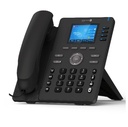


Voice clarity is the first thing a customer notices on a call. Alcatel-Lucent lists HD wideband audio on the H3G and H6, and super wideband audio on the M3 and M8. What do these terms mean, and what do you need to get that quality on real calls? This guide explains.
1. The three audio bands
- Narrowband: about 300 to 3,400 Hz, the sound of the traditional telephone.
- Wideband: about 50 to 7,000 Hz, known as HD voice, which makes similar sounds such as "s" and "f" easier to tell apart.
- Super wideband: extends to about 14,000 Hz, bringing the sound closer to a face-to-face conversation.
2. The codecs on ALE phones
The H3G, H6, M3 and M8 support the same codecs, and this is what each one offers:
- G.711: uncompressed narrowband at 64 kbps, the most compatible with telephone networks.
- G.729AB: compressed narrowband at 8 kbps, for low-bandwidth links.
- G.726: narrowband at rates from 16 to 40 kbps.
- iLBC: designed to tolerate packet loss on unstable networks.
- G.722: wideband at 64 kbps, the basis of HD voice.
- Opus: a flexible codec that adapts its rate to the network; the H3G and H6 pages list it for narrowband and wideband.
3. Why are not all calls HD?
HD voice needs both ends and the PBX to support the same wideband codec, such as G.722. A call between two internal phones is HD if G.722 is first in the codec order, while calls over traditional telephone lines usually fall back to narrowband. If the PBX transcodes to G.711 or G.729, the quality is lost even between two HD-capable phones.
Put G.722 first in the codec order on the phones and the PBX, then G.711 for outside calls, and keep G.729 for branches with limited internet.
4. Speakerphone and headsets
The H3G and H6 pages list a full-duplex speakerphone, meaning both sides can talk at once without the audio cutting out. The M3 page lists echo cancelling, and the M8 page 360-degree sound pickup. The AH11G and AH11GA headsets are wideband with a noise-cancelling microphone, which helps in busy offices.
5. Network quality
- Put voice on its own VLAN and enable voice priority (QoS) on the switch and router.
- Delay, jitter and packet loss affect quality more than the internet speed itself.
- For branches with limited internet, G.729 or Opus saves bandwidth.
- For an M8 on Wi-Fi, prefer the 5 GHz band, which is usually less congested.
Audio on each phone
| Phone | Audio per our page | Speakerphone |
|---|---|---|
| Alcatel-Lucent ALE-H3G | HD wideband | Full-duplex |
| Alcatel-Lucent ALE-H6 | HD wideband | Full-duplex |
| Alcatel-Lucent ALE-M3 | Super wideband | With echo cancelling |
| Alcatel-Lucent ALE-M8 | Super wideband | 360-degree pickup |
To compare the models, see our guide to choosing ALE deskphones.
For headsets, see our guide to the AH11G and AH11GA headsets.
Products mentioned in this guide
- Alcatel-Lucent ALE-H3G – HD wideband audio
- Alcatel-Lucent ALE-H6 – HD audio, color screen
- Alcatel-Lucent ALE-M3 – Super wideband with echo cancelling
- Alcatel-Lucent ALE-M8 – Super wideband, 360-degree pickup
- Alcatel-Lucent AH11G – Wideband headset
Frequently asked questions
Does G.722 use more bandwidth than G.711?
No, both run at 64 kbps, but G.722 carries a wider audio band.
Are calls to mobiles HD?
Usually not over traditional telephone lines, which run in narrowband.
Which codec is best for branches?
G.722 on the local network, and G.729 or Opus when the link is slow.
Need help choosing the right Alcatel-Lucent solution?
Rasid's team in Riyadh helps you choose the right equipment for your site and handles supply, installation and programming for businesses, hotels and homes in Saudi Arabia. Message us on WhatsApp +966559790746 or request a solution for your project.