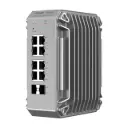
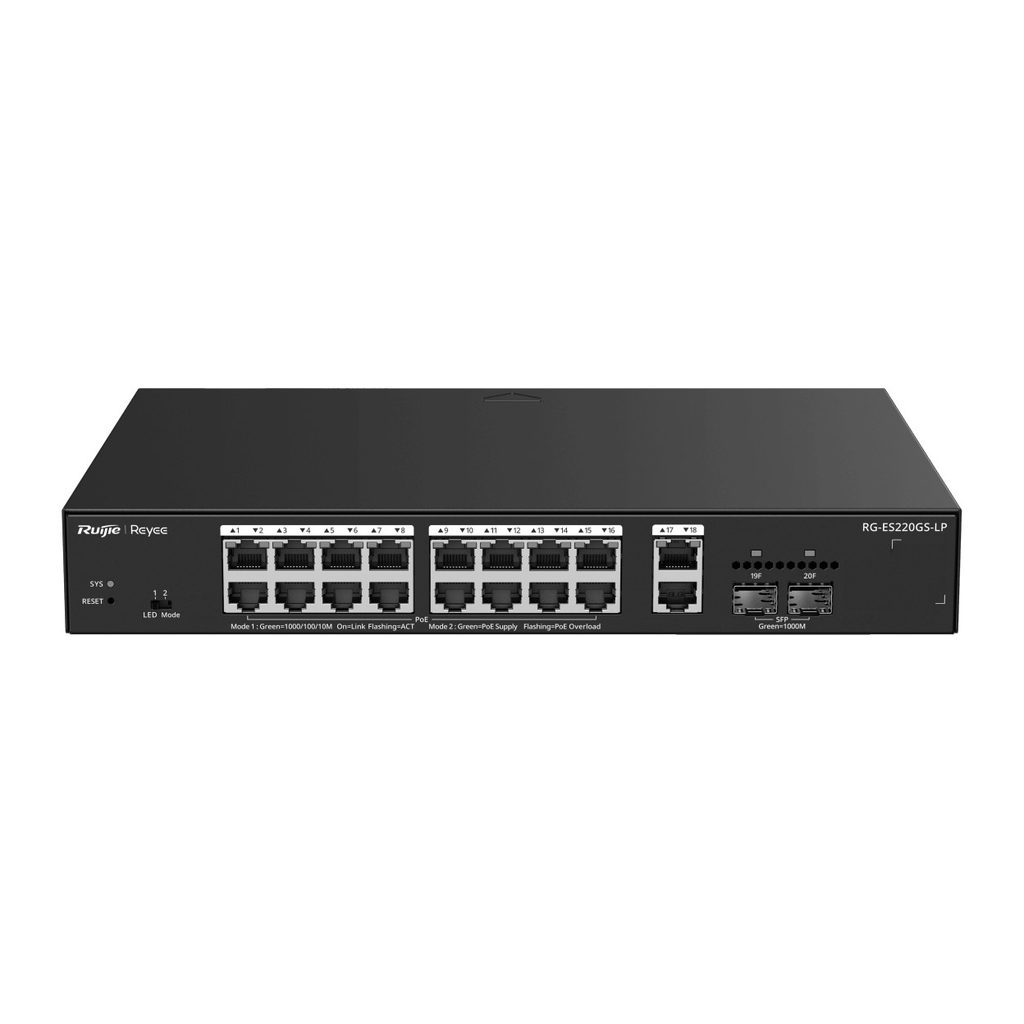
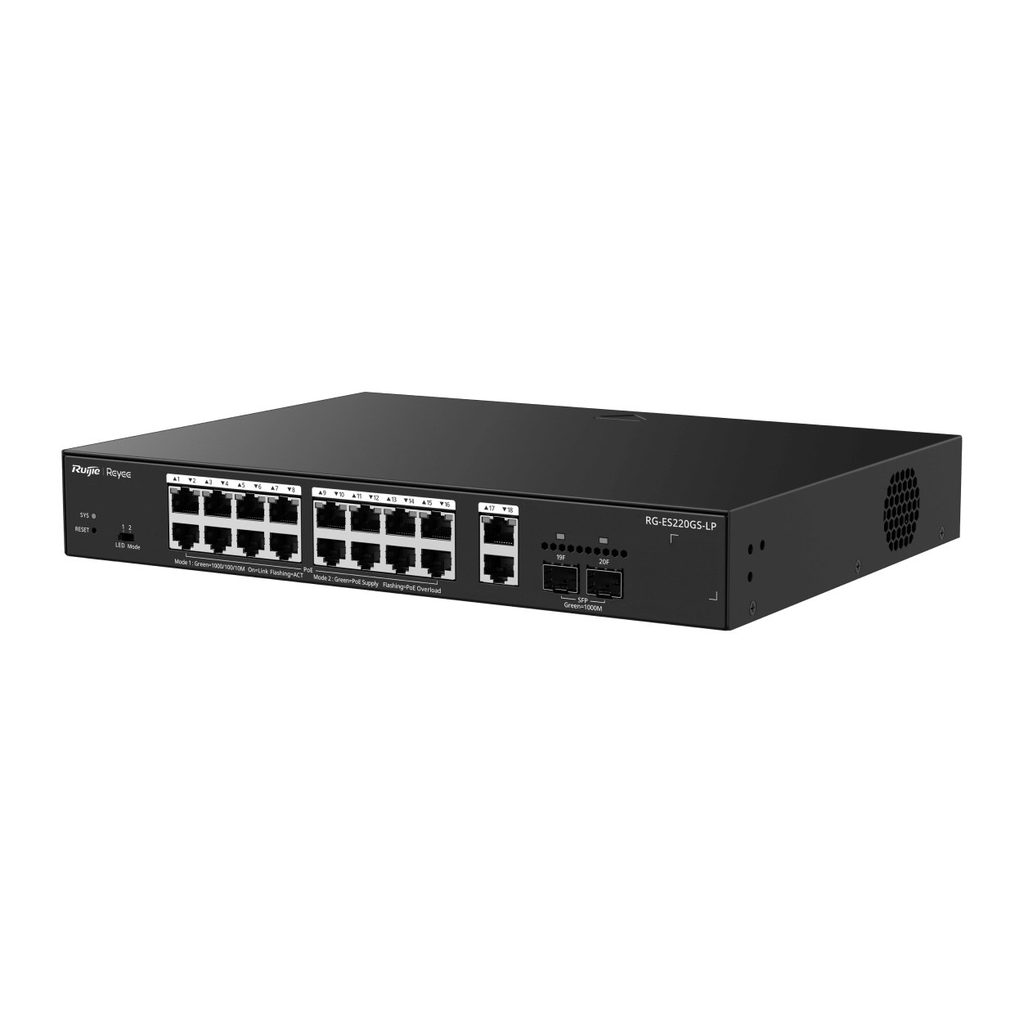
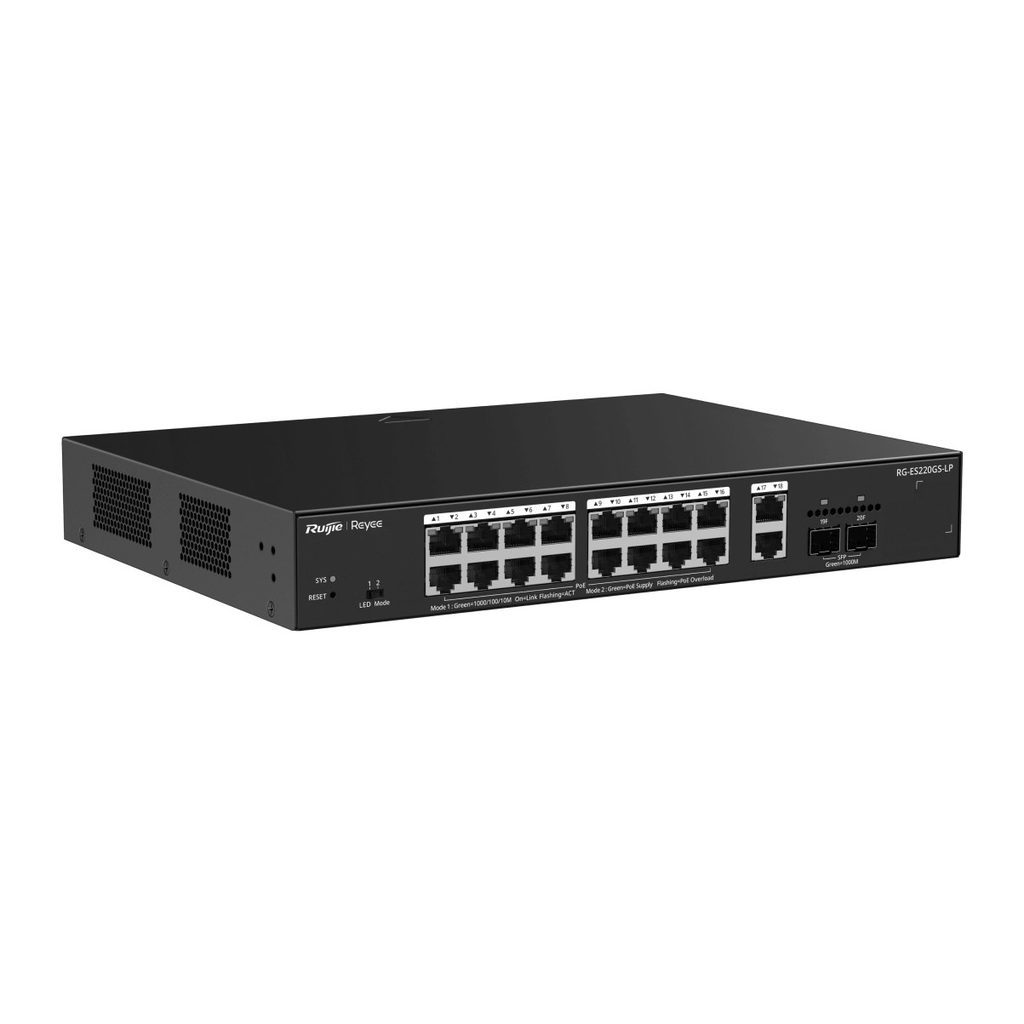
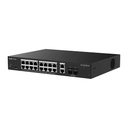
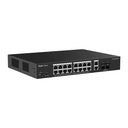
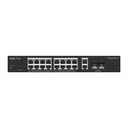
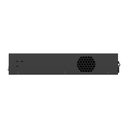
Overview of Reyee RG-ES220GS-LP
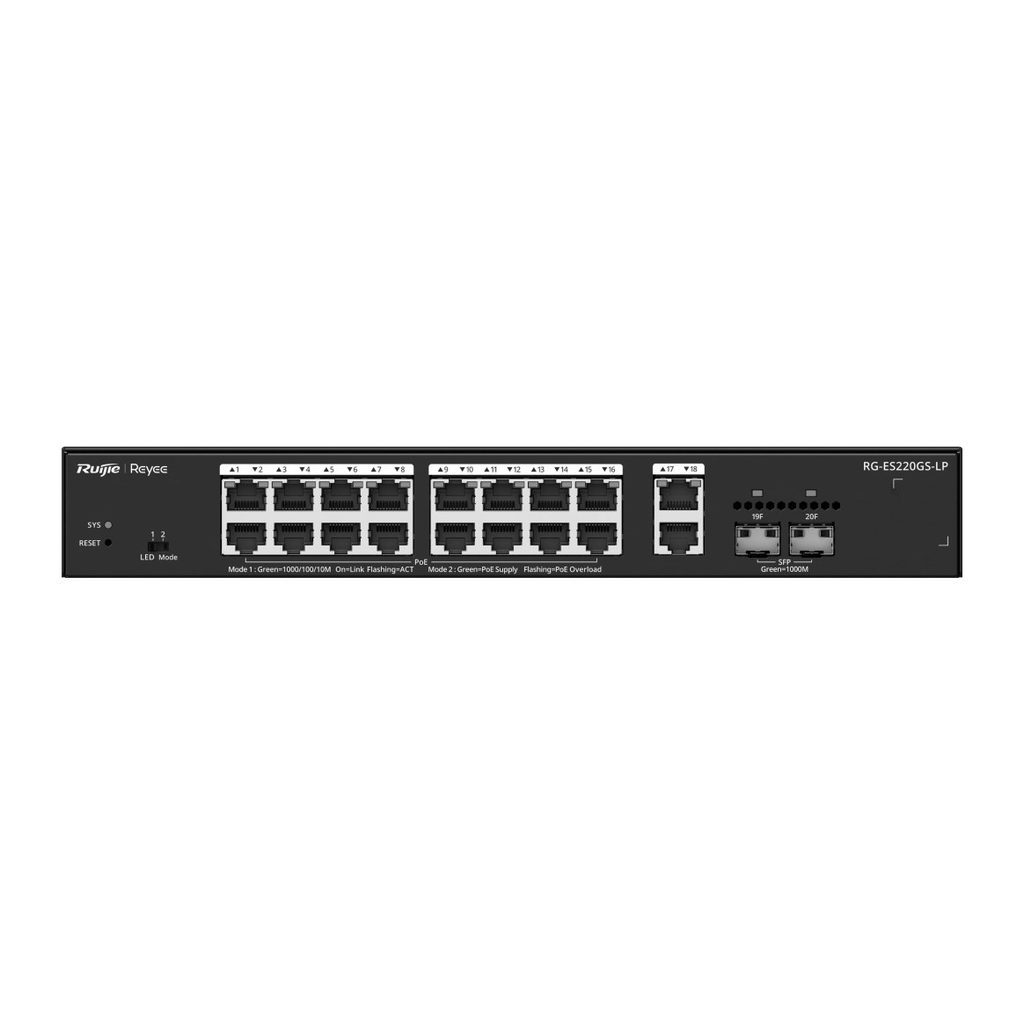
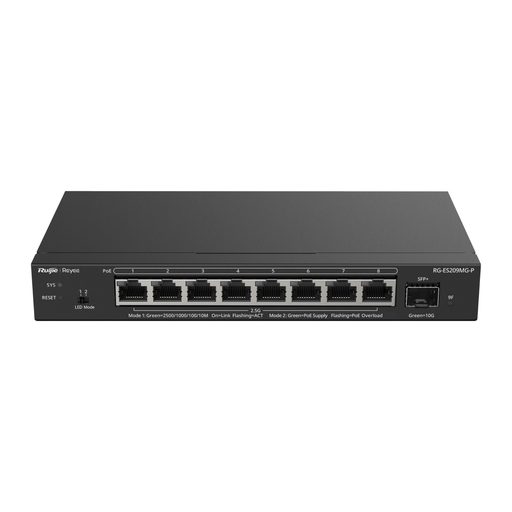
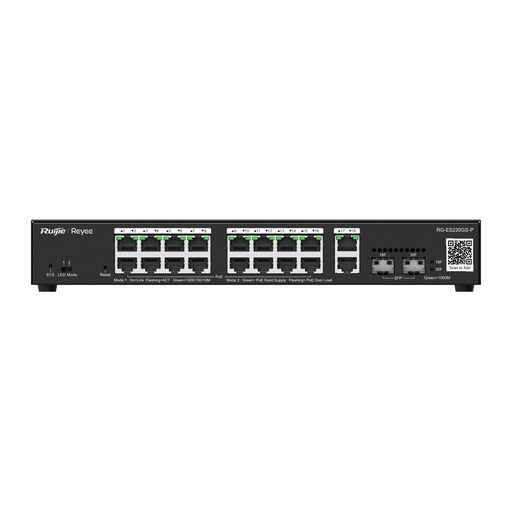
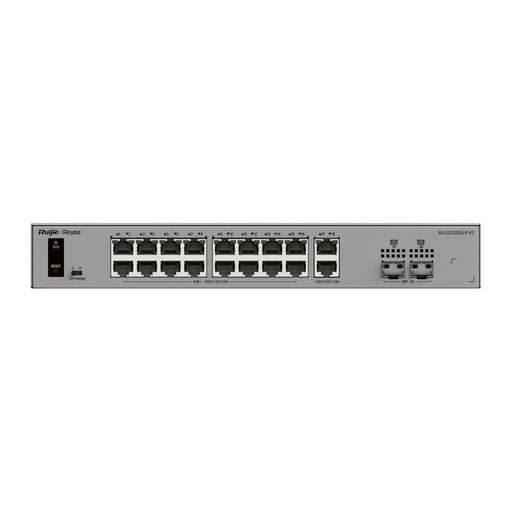
The Reyee RG-ES220GS-LP is a 20-port Gigabit smart cloud-managed PoE switch designed for SMB networks, with 16 IEEE 802.3af/at PoE+ ports, 2 Gigabit RJ45 ports and 2 SFP uplinks sharing a 130 W PoE budget. Its fanless design runs silently, making it a good fit for offices, clinics, schools, hotels and retail stores. For surveillance it provides IP camera/NVR recognition, IPC offline alarms, individual port reboot and an extend mode for up to 250 meters at 10 Mbps. Automatic loop prevention and PoE watchdog protect uptime, and SON, mobile VLAN configuration and lifetime Ruijie Cloud management simplify daily operation.
Technical Specifications – Reyee RG-ES220GS-LP
Product Information
| Product Category | Layer 2 |
|---|
| Warranty | 3 years |
|---|
Port Specifications
| Total number of RJ45 ports | 18 |
|---|
| Total number of optical ports | 2 |
|---|
| Number of 1GE SFP ports | 2 |
|---|
| Number of 10/100/1000BASE-T ports | 18 |
|---|
| Reset button | 1 |
|---|
Power Supply and Consumption
| PoE Out standard | PoE/PoE+ (IEEE 802.3af/at) |
|---|
| Number of PoE/PoE+ Out ports | 16 |
|---|
| PoE budget | 130 W |
|---|
| PoE power pins | 1–2 (+), 3–6 (-) |
|---|
| Power input | 220 V AC power supply: Rated input voltage: 100 V AC to 240 V AC, 50 Hz to 60 Hz; Maximum input voltage: 90 V AC to 264 V AC, 47 Hz to 63 Hz; Rated input current: 3 A |
|---|
| Maximum power consumption | Less than 15W with no PoE load (110V); Less than 14W with no PoE load (220V); Less than 160W with PoE full load (110V); Less than 157W with PoE full load (220V) |
|---|
| Power supply | Fixed power supply |
|---|
System Specifications
| Flash memory | 8 MB |
|---|
| Forwarding rate | 29.76 Mpps |
|---|
| Switching capacity | 40 Gbps |
|---|
Dimensions and Weight
| Casing | Metal |
|---|
| Product dimensions (W x D x H) | 300 mm x 223 mm x 43.6 mm (11.81 in. x 8.78 in. x 1.72 in.) |
|---|
| Weight | 2.10 kg (4.63 lbs) (without packaging materials); 3.10 kg (6.83 lbs) (with packaging materials) |
|---|
| Shipping weight | 3.10 kg (6.83 lbs) |
|---|
Environment and Reliability
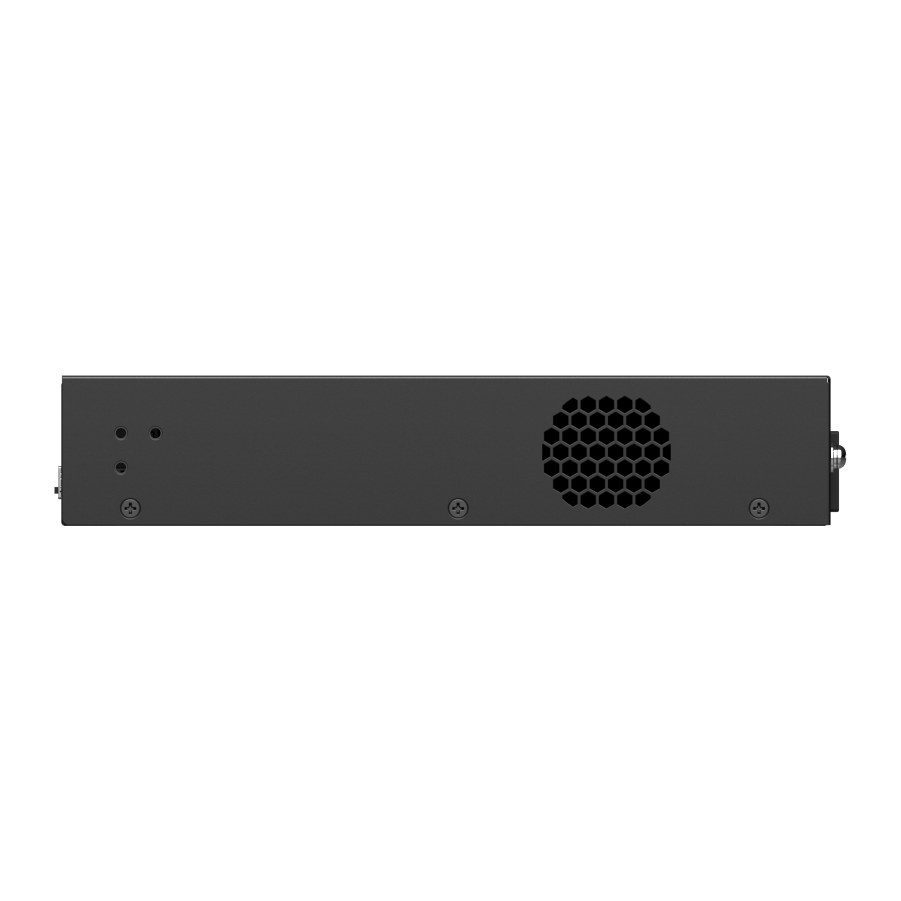
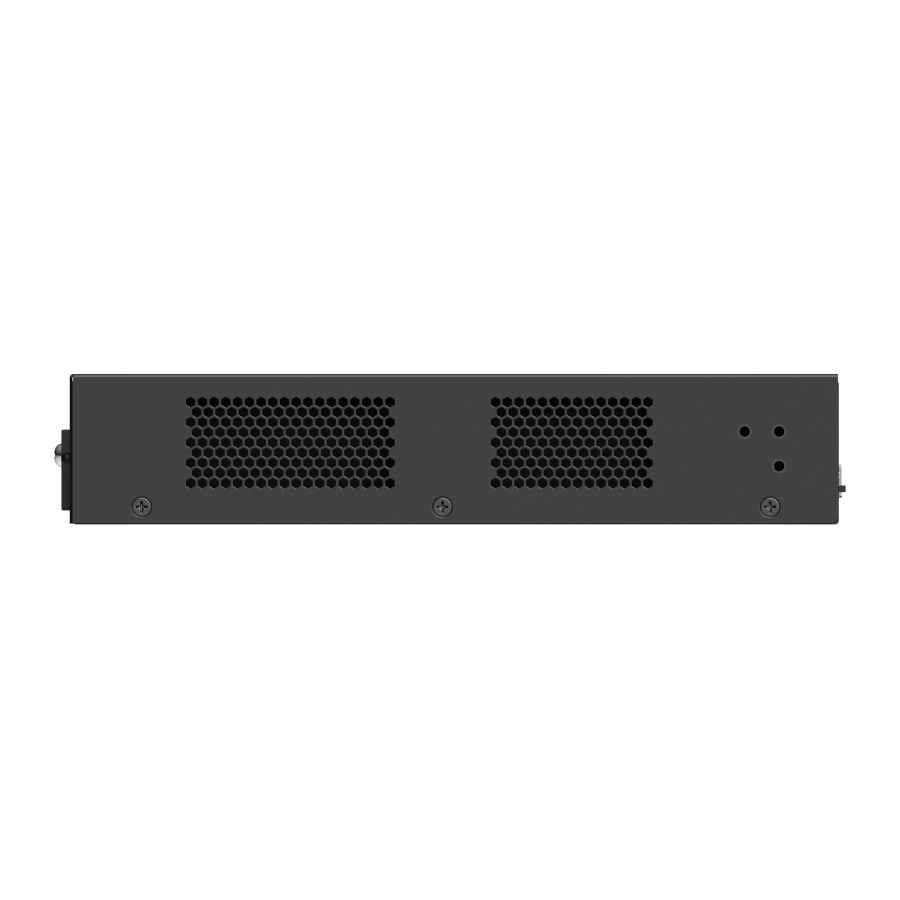
| Fan | Fanless design |
|---|
| Cooling | Natural cooling |
|---|
| Mounting options | Desk/Rack |
|---|
| Hot swapping of cables | Hot swapping supported by the service port and power connector |
|---|
| MTBF | 200,000 hours |
|---|
| Operating temperature | 0°C to 40°C (32°F to 104°F) |
|---|
| Storage temperature | –40°C to +70°C (–40°F to +158°F) |
|---|
| Operating humidity | 10% RH to 90% RH (non-condensing) |
|---|
| Storage humidity | 5% RH to 95% RH (non-condensing) |
|---|
| Altitude | –500 m to +5,000 m (–1,640.42 ft. to +16,404.20 ft.) |
|---|
| ESD protection | Air discharge: 8 kV; Contact discharge: 6 kV |
|---|
| Surge protection | Service port: ±6 kV for common mode; Power connector: ±6 kV for common mode and ±6 kV for differential mode |
|---|
Certification and Regulatory Compliance
| EMC | EN 55032, EN 61000-3-2, EN 61000-3-3, EN 55035, EN 300 386 |
|---|
| Safety compliance | EN 62638-1 |
|---|
| Certification | CE, CB |
|---|
Basic Configurations
| PoE watchdog | Yes |
|---|
| Online upgrade | Yes |
|---|
Ethernet Switching
| Maximum number of VLANs | 16 |
|---|
| Maximum number of MAC address entries | 8000 |
|---|
| Interface flow control | Yes |
|---|
| IEEE 802.1Q VLAN | Yes |
|---|
| VLAN configuration supported on LAN ports | Yes |
|---|
| Static MAC address | Yes |
|---|
| Inbound or outbound rate limiting based on interface traffic | Yes |
|---|
Interface
| Jumbo frame length (MTU) | 10000 bytes |
|---|
| EEE | Yes |
|---|
| Cable test | Yes |
|---|
IP Service
| DNS client | Yes |
|---|
| DHCP client | Yes |
|---|
Network Management and Monitoring
| Mirroring | Yes |
|---|
| HTTP login | Yes |
|---|
| HTTPS login | Yes |
|---|
| SON | Yes |
|---|
| Camera detection | Yes |
|---|
| eWeb management | Yes |
|---|
| Ruijie Cloud management | Yes |
|---|
| Ruijie Reyee App management | Yes |
|---|
Security
| Port isolation | Yes |
|---|
| Broadcast storm control | Yes |
|---|
| Multicast storm control | Yes |
|---|
| Unknown unicast storm control | Yes |
|---|
| DHCP snooping | Yes |
|---|
| CPU Protection Policy | Yes |
|---|
System Performance Capacity
| Recommended camera limit | 200W H265: 80; 400W H265: 40 |
|---|
Source: Ruijie Reyee official website and datasheet. Specifications are subject to change by the manufacturer.