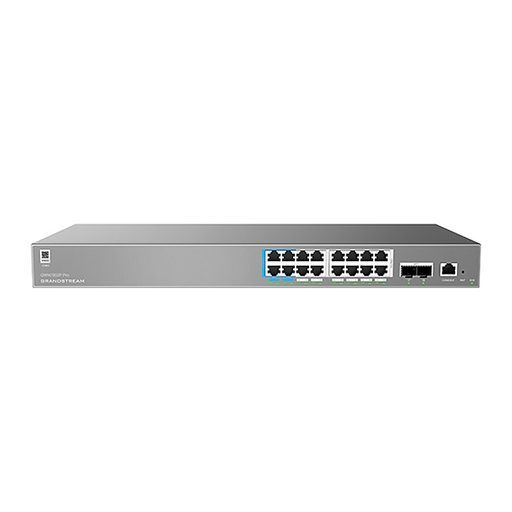
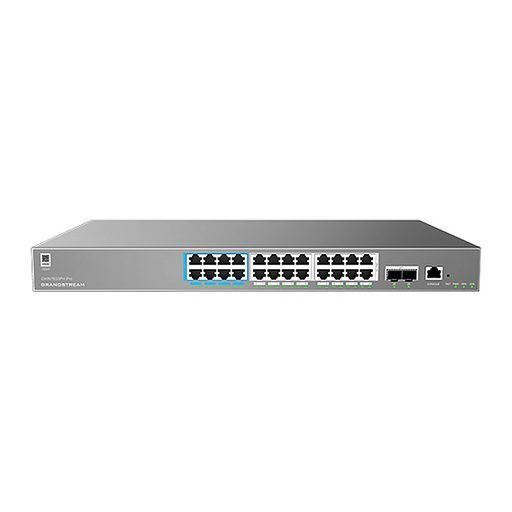
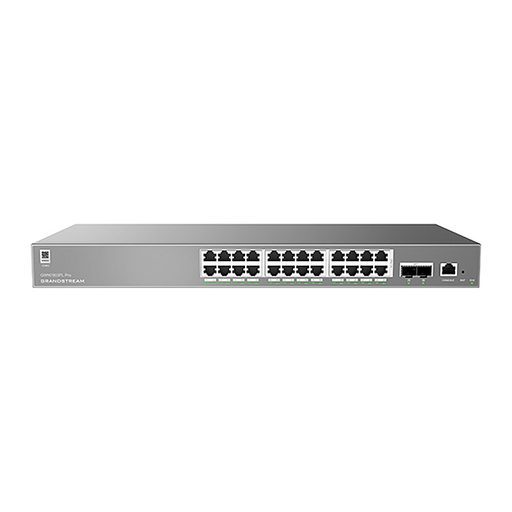
Overview of Grandstream GWN7806PL Pro
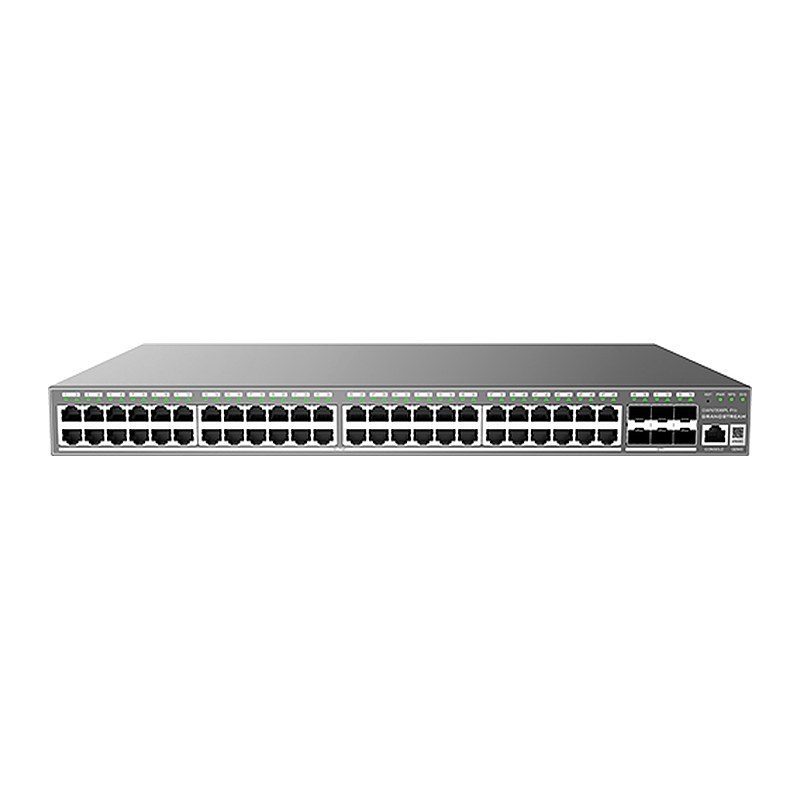
The Grandstream GWN7806PL Pro is an enterprise Layer 2++ managed network switch with 48 Gigabit Ethernet ports and 6 SFP+ ports, delivering 216 Gbps switching capacity for scalable, secure and high-performance business networks. It offers advanced VLAN for flexible traffic segmentation, advanced QoS, IGMP/MLD Snooping and comprehensive security including ARP inspection, IP source guard and DoS protection. Its PoE ports deliver smart dynamic IEEE 802.3af/at power (400W total) to IP phones, IP cameras and Wi-Fi access points. It also supports stacking of up to 8 units and policy routing. Management is free and flexible via GDMS Networking, GWN Manager, the embedded web controller, GWN Series Routers and CLI. It is ideal for offices, schools, hospitals and hotels.
Technical Specifications – Grandstream GWN7806PL Pro
Ports
| Gigabit Ethernet Ports | 48 |
|---|
| SFP/SFP+ Ports | 6 × SFP+ |
|---|
| Maximum Number of Supported Modules | SM-10G: 6; MM-10G: 6; RJ45-10G: 3 (RJ45-10G modules must be inserted at intervals) |
|---|
| MGMT Ports | 1 × Console port |
|---|
| Others | 1 × Reset Pinhole |
|---|
LEDs
| System LEDs | 1 × tri-color LED for device tracking and status indication |
|---|
| Power Supply LEDs | 2 × green LEDs, one for each power source (PWR & RPS) |
|---|
| Data Transferring LEDs | 54 × green-color LEDs |
|---|
| PoE Supply LEDs | 48 × yellow-color LEDs |
|---|
System
| Flash | 8 MB Nor Flash, 128 MB Nand Flash |
|---|
| RAM | 512 MB RAM |
|---|
| CPU | Dual-core, MIPS interAptive 1GHz |
|---|
Performance
| Forwarding Mode | Store-and-forward |
|---|
| Total Non-blocking Throughput | 108 Gbps |
|---|
| Switching Capability | 216 Gbps |
|---|
| Forwarding Rate | 160.704 Mpps |
|---|
| Packet Buffer | 8.4 Mb |
|---|
| Network Latency | <4 µs |
|---|
Power
| Power Supply | 100–240 V AC, 50/60 Hz |
|---|
| Power Redundancy Scheme | 1+1 External RPS |
|---|
| External Redundant Power Supply (pending) | 460 W |
|---|
| Max Power Consumption | 65.4 W / 509.3 W (PoE 400 W) |
|---|
| Max Output Power | 509.3 W |
|---|
PoE
| PoE Standards | IEEE 802.3af/at |
|---|
| PoE Ports | 48 |
|---|
| Max Output Power per PoE Port | 30 W |
|---|
| Max Total PoE Output Power | 400 W |
|---|
Protocols
| Network Protocol | IPv4, IPv6, IEEE 802.3, IEEE 802.3i, IEEE 802.3u, IEEE 802.3ab, IEEE 802.3z, IEEE 802.3ae, IEEE 802.3az, IEEE 802.3ad, IEEE 802.3x, IEEE 802.3af/at/bt, IEEE 802.1p, IEEE 802.1Q, IEEE 802.1d, IEEE 802.1w, IEEE 802.1s, IEEE 802.1x |
|---|
Switching
| Stacking | Yes, up to 8 devices |
|---|
| VLAN & Jumbo Frame | Jumbo frame (maximum length: 12288); 4K VLANs, port-based VLAN, IEEE 802.1Q VLAN tagging; QinQ; MAC-based VLAN; Protocol-based VLAN; VLAN translation including VLAN mapping and VLAN stacking; Voice VLAN including auto voice VLAN, tagged OUI and untagged OUI; GVRP (pending); ERPS; Private VLAN |
|---|
| Spanning Tree | Spanning tree: STP/RSTP/MSTP/PVST(+)/RPVST(+), 64 instances for MSTP/PVST(+)/RPVST(+) |
|---|
| MAC Addresses | 32K MAC addresses (static/dynamic/filtering) with migration records |
|---|
| Link Aggregation | Link aggregation including static and LACP; up to 32 LAG groups and up to 8 members per group |
|---|
IP Service
| IP Service | DHCP client, DHCP server, DHCP relay and DHCP snooping; DHCPv6 client and DHCPv6 snooping; ND snooping; DNS; 1K ARP/NDP, including static and dynamic ARP/NDP; 32 VLAN virtual interfaces with 9216 MTU |
|---|
IP Routing
| IP Routing | 1K (IPv4) / 1K (IPv6) static routes, supporting user-defined static routing entries; Policy routing |
|---|
Multicast
| Multicast | IGMP Snooping with IGMPv2 and IGMPv3, 640 IGMP Snooping groups; MLD Snooping with MLDv1 and MLDv2, 640 MLD Snooping groups |
|---|
QoS
| AV Control | Pro AV |
|---|
| QoS | Port priority; priority mapping including 802.1p, DSCP and IP precedence mapping; queue scheduling including SP, WRR, WFQ, SP-WRR and SP-WFQ; traffic shaping; rate limit |
|---|
ACL
| ACL | 256 ACL for Ethernet, IPv4 and IPv6 with 4K total ACEs; MAC, IPv4 and IPv6 hardware ACLs (with time range); ACL redirection; ACL advanced settings including statistics, mirror, priority mapping and rate limit; ACL binding to port and VLAN |
|---|
Security
| Security | User hierarchical management and password protection, HTTPS, SSH, Telnet; 802.1X and MAC authentication; AAA authentication including RADIUS, TACACS; storm control; port isolation; port security, sticky MAC address, filtering invalid MAC addresses; IP/IPv6 source guard, DoS attack prevention, ARP inspection, CPU protection; loop protection including port loopback detection, BPDU protection, root protection and loopback protection; Kensington Security Slot support; firmware signature |
|---|
Reliability
| Reliability | Power supply modules in 1+1 redundancy mode; Stack intelligent upgrade; NTP; IEEE 1588v2 TC (PTPv2, RFC 8173) for precise time |
|---|
Maintenance
| Maintenance | SNMPv1/v2c/v3; RMON (history, event, alarm and statistics groups); LLDP & LLDP-MED; backup and restore; Syslog; alert; diagnostics including Ping, traceroute, Ping watchdog, SPAN/RSPAN mirror, capture, copper test, fiber module and one-click debugging; sFlow; upgrade via FTPS/TFTP/HTTP/HTTPS or local upload; mass provisioning using DHCP Option / TR-069 (pending) / GDMS Networking / GWN Manager / GWN series routers |
|---|
Management
| Management Platform | Local Web GUI with embedded controller; GDMS Networking (free cloud management); GWN Manager (on-premises software controller); GWN App via GDMS Networking and GWN Manager; management protocols: SNMP, RMON, TR-069 (pending) |
|---|
Monitoring
| Device Monitoring | CPU usage monitoring and over-CPU usage alarming; memory usage monitoring and alarming; power supply model/status monitoring and failure alarming; temperature monitoring and over-temperature alarming; fan automatic speed adjustment and fan failure alarming |
|---|
Physical
| Fan | 3 |
|---|
| Unit Dimensions (L × W × H) | 440 mm × 300 mm × 44 mm (17.32″ × 11.81″ × 1.73″) |
|---|
| Unit Weight | 5.05 kg (11.13 lb) |
|---|
| Mounting | Desktop or Rack-Mount (rack-mounting kits included) |
|---|
| Package Content | 1 × Switch, 1 × 25 cm (9.84″) Ground Cable, 4 × Rubber Footpads, 1 × Power Cord Anti-Trip, 8 × Flat Head Machine Screws (M3 × 6 mm), 1 × 1.2 m (3.94 ft) AC Cable of 10 A, 1 × Simplified Quick Installation Guide, 1 × Regulatory Paper, 2 × Rack-Mounting Kits |
|---|
Environmental
| Temperature | Operating: 0 °C to 45 °C (32 °F to 113 °F); Storage: -10 °C to 60 °C (14 °F to 140 °F) |
|---|
| Humidity | Operating: 10%–90% (RH), non-condensing; Storage: 5%–95% (RH), non-condensing |
|---|
| MTBF | 70,000 hours |
|---|
| Surge Protection | ±6 kV CM for power; ±4 kV CM for network ports |
|---|
| ESD | ±12 kV for contact discharge |
|---|
Certification
| Certification | FCC, CE, RCM, IC |
|---|
Source: Grandstream official website and datasheet. Specifications are subject to change by the manufacturer.