
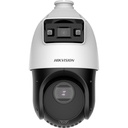





Customers often ask us: should we install IP or analog cameras? The answer depends on the site, the existing cabling and the budget. Hikvision offers both, and both now deliver high-resolution video, but each has its strengths.
How does each system work?
- IP system: each camera is a network device sending digital video over a network cable to an NVR, usually taking its power from the same cable over PoE.
- Turbo HD system: the camera sends high-definition video over coaxial cable to a DVR and usually needs a separate power wire.
Quick comparison
| Aspect | IP | Turbo HD |
|---|---|---|
| Resolution | 8 MP and beyond | up to 8 MP (4K) |
| Cable | network cable for video and power | coaxial cable plus a power wire |
| Recorder | NVR | DVR that also accepts some IP cameras |
| Smart features | in the camera: AcuSense and perimeter protection | in the DVR: Motion Detection 2.0 people and vehicle classification |
| Audio | built-in microphone on many models | audio over the coaxial cable on selected models |
| Best for | new installations, projects and smart analytics | upgrading older systems on existing cables |
Turbo HD strengths you may not know
Today's Turbo HD cameras are not the analog of the past: there are 3K and 4K ColorVu cameras, Smart Hybrid Light and audio over coax. Many support four switchable signals (TVI, AHD, CVI and CVBS), so they work with different recorders. AcuSense DVRs such as the iDS-7208HUHI-M1/X accept five signal types including IP, with up to 16 IP channels.
In resolution, Turbo HD reaches 8 MP with cameras such as the DS-2CE72UF3T-E, but its datasheet gives 12.5 or 15 frames per second at that resolution, while an IP camera such as the DS-2CD2087G2H-LIU records 4K at 25 frames per second. So where fast movement matters, IP is the better choice.
When to choose IP
- A completely new installation.
- You need accurate smart analytics in every camera.
- Long distances and a network spread across switches or fibre.
- Advanced PTZ or panoramic cameras, or resolutions above 8 MP.
When to choose Turbo HD
- You have existing coax and want a better picture without new cabling.
- A limited budget for a small project.
- You want simple operation without network setup.
You can also combine both: keep your existing Turbo HD cameras on a hybrid DVR and add IP cameras where you need more resolution or analytics.
To pick the right recorder, see our Hikvision NVR buying guide.
Products mentioned in this article
- Hikvision DS-2CD2T83G2-2LI – 8 MP AcuSense IP bullet with Smart Hybrid Light
- Hikvision DS-2CD2087G2H-LIU – 8 MP ColorVu IP mini bullet recording 4K at 25 fps
- Hikvision DS-2CE10KF0T-LPFS – 3K ColorVu Turbo HD camera, hybrid light, four signals
- Hikvision DS-2CE16U0T-LF – 4K metal Turbo HD mini bullet with Smart Hybrid Light
- Hikvision DS-2CE72UF3T-E – 4K ColorVu Turbo HD turret, white light up to 40 m
- Hikvision iDS-7208HUHI-M1/X – 8-channel AcuSense DVR with five signal types
- Hikvision iDS-7216HQHI-M1/XT – 16-channel AcuSense DVR with face recognition
Frequently asked questions
Can I reuse old coaxial cables with new Turbo HD cameras?
Usually yes, if the cables are in good condition; that is one of the main advantages of Turbo HD. We test the cables during the site visit to confirm signal quality.
Which is cheaper: IP or Turbo HD?
It depends on the project: for a new installation the cabling cost is similar, while for an upgrade Turbo HD saves the cost of new cables.
Do Turbo HD cameras work with the phone app?
Yes. A Hikvision DVR connects to the internet and shows the cameras in the Hik-Connect app, just like an NVR.
Need help choosing the right Hikvision system?
Rasid's team in Riyadh helps you pick the right models for your site and handles supply, installation, setup and mobile access for homes and businesses in Saudi Arabia. Message us on WhatsApp +966559790746 or request a solution for your project.