




A lecture, a ceremony or the Friday sermon needs clear sound without feedback or dropouts, starting with a good microphone and ending with the right speaker for the room. DSPPA offers wireless microphones, mixers, processors and professional speakers. This guide explains how to choose.
1. UHF wireless microphones
DSPPA wireless microphones work on UHF, and models such as the D5811 use true diversity reception, which reduces dropouts and extends range, with infrared pairing between transmitter and receiver. The D5821 comes with two handheld microphones and the D5822 with two clip-on microphones; the D5815 receiver has two channels with 200 selectable frequencies and auto-scan, and the D5816 has four channels with separate and mixed XLR outputs.
The D5811 also has a module that carries the microphone audio over the network, and its buttons can start background music or an emergency page on a DSPPA IP system.
2. The mixer
A mixer combines microphones and music sources and sets the level of each. The DMX12 and DMX16 have 12 and 16 balanced XLR inputs, 3-band EQ on each channel, 48 V phantom power for condenser microphones and 16 digital effects, with USB playback and recording and Bluetooth. For smaller systems there are the 8-channel DMX08 and the CM208 rack mixer with 8 inputs and two output groups.
3. Stopping feedback and tuning the sound
Feedback happens when a microphone picks up its own speaker, and the D6576 automatic feedback suppressor reduces it. The D6575 audio processor has a 32-bit DSP at 96 kHz, 4 music inputs and 5 microphone inputs in three groups, 3.1, 4 or 5.1 outputs, and PC control over USB. To switch equipment on and off in the right order, the D6721S sequencer protects the speakers from turn-on thumps.
4. Hall speakers and professional amplifiers
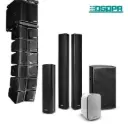
For mid-size halls, the D6563 has an 8-inch woofer, 150 W, up to 117 dB and 90°×40° coverage, and the D5A wall bracket is available for professional speakers. A stereo amplifier such as the MX1000II (2×150 W into 8 Ω) or MX2000II (2×300 W) drives it. For theatres and large events there is the DSP1280 active line array with 800 + 800 W.
5. Sound in the classroom
A teacher does not need a big system: the DSP2021A or DSP2021B 2.4 GHz wireless teaching system automatically finds an interference-free channel and pairs by infrared or wirelessly, with only 15 ms of audio delay.
Examples by use
| Use | Solution | Example |
|---|---|---|
| Sermon or lecture | Two wireless microphones | DSPPA D5821 |
| Presenter on the move | Clip-on microphones | DSPPA D5822 |
| Event with many microphones | 16-channel mixer | DSPPA DMX16 |
| Hall with feedback | Feedback suppressor | DSPPA D6576 |
| Mid-size hall | 150 W speaker and stereo amplifier | DSPPA D6563 |
| Theatre or large event | Active line array | DSPPA DSP1280 |
| Classroom | Wireless teaching system | DSPPA DSP2021A |
For a fixed system in a mosque or school, see our guide to DSPPA mixer amplifiers.
Products mentioned in this guide
- DSPPA D5811 – UHF handheld, true diversity
- DSPPA D5821 – Wireless system with two handhelds
- DSPPA D5822 – Wireless system with two clip-on mics
- DSPPA D5815 – 2-channel receiver, 200 frequencies
- DSPPA D5816 – 4-channel receiver with XLR outputs
- DSPPA CM30 – Condenser gooseneck, 48 V phantom
- DSPPA DMX12 – 12-channel mixer with effects, USB and Bluetooth
- DSPPA DMX16 – 16-channel mixer
- DSPPA D6576 – Automatic feedback suppressor
- DSPPA D6575 – 32-bit DSP audio processor
- DSPPA D6721S – Rack power sequencer
- DSPPA D6563 – 8-inch 150 W professional speaker
- DSPPA MX1000II – Stereo amplifier, 2×150 W
- DSPPA MX2000II – Stereo amplifier, 2×300 W
- DSPPA DSP1280 – Active line array, 800 + 800 W
- DSPPA DSP2021A – 2.4 GHz wireless teaching system
Frequently asked questions
Why does a wireless microphone drop out?
Usually because of interference, distance or a weak battery. True diversity reception and choosing a clear frequency with auto-scan, as on the D5815, reduce the problem.
How many wireless microphones can run together?
Each receiver channel serves one microphone, so the D5815 takes two and the D5816 four; for more, use several receivers on different frequencies.
What is phantom power for?
It powers condenser microphones such as the CM30 through the microphone cable itself, and the DMX12 and DMX16 mixers provide it at 48 V.
Need help choosing the right DSPPA solution?
Rasid's team in Riyadh helps you choose the right equipment for your site and handles supply, installation and programming for businesses, hotels and homes in Saudi Arabia. Message us on WhatsApp +966559790746 or request a solution for your project.