

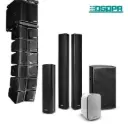


In mosques, schools and shopping centres, speakers are spread over long distances, and this is where the 100 V line system comes in. Most DSPPA speakers and amplifiers use it. This guide explains the idea simply and how to size the right amplifier.
1. The idea
In a 100 V system the amplifier raises the signal voltage, so the current in the cable is lower, losses over long runs drop, and many speakers can be connected in parallel on one line. Each speaker has a small transformer that sets how much power it draws from the line.
2. Power taps
The transformer taps set each speaker's power: the DSP8064 wall speaker, for example, offers 40, 20, 10, 5 or 2.5 W, and the DSP1650 horn offers 6, 12.5, 25 or 50 W on a 100 V line. So you can raise the level in a yard and lower it in an office on the same line.
3. How to size the amplifier
Add up the power you chose for every speaker on the line, then add a margin for safety and growth; around 20 to 30% is common. Example: 20 ceiling speakers on the 6 W tap total 120 W, so a 250 W amplifier such as the MP250UB or DMA250U fits, with room to add speakers later.
| Speakers | Total power | Suitable amplifier |
|---|---|---|
| 10 × 6 W | 60 W | DSPPA MP120UB |
| 20 × 6 W | 120 W | DSPPA MP250UB |
| 30 × 10 W | 300 W | DSPPA DMA500U |
| 40 × 10 W and 4 horns × 25 W | 500 W | DSPPA DMA650U |
| Over 1,000 W | Separate power amplifier | DSPPA DA3850 |
4. Power amplifiers for 100 V lines
If you already have a source or mixer, a power amplifier feeds the line directly: the MP6450 gives 500 W with 100 V, 70 V and 4 Ω outputs, and the Class-D DA series includes the DA3750 at 1,000 W and the DA3850 at 1,500 W on 100 V. The DA4060, DA4125 and DA4250 have four channels to feed several lines and accept 24 V DC, which allows battery backup.
5. Volume control per room
The WH-1II wall volume control fits in a room to lower its 100 V or 70 V speakers, supports emergency override so urgent calls play at full level, and accepts 2-, 3- or 4-wire connection; override usually needs the 3- or 4-wire connection.
To choose the right amplifier for your space, see our guide to DSPPA mixer amplifiers.
Products mentioned in this guide
- DSPPA MP120UB – 120 W mixer amplifier, 100/70 V output
- DSPPA MP250UB – 250 W mixer amplifier
- DSPPA DMA250U – 250 W mixer amplifier with chime and siren
- DSPPA DMA500U – 500 W mixer amplifier
- DSPPA DMA650U – 650 W mixer amplifier
- DSPPA MP6450 – 500 W power amplifier, 100/70 V and 4 Ω
- DSPPA DA3750 – 1,000 W Class-D amplifier
- DSPPA DA3850 – 1,500 W Class-D amplifier
- DSPPA DA4060 – 4 × 60 W, accepts 24 V DC
- DSPPA DA4250 – 4 × 250 W
- DSPPA DSP8064B – 40 W wall speaker with power taps
- DSPPA WH-1II – Wall volume control with emergency override
Frequently asked questions
What if the speakers add up to more than the amplifier power?
The amplifier is overloaded, runs hot and distorts, and its protection may shut it down, so choose a bigger amplifier, lower the taps or split the speakers between two amplifiers.
What is the difference between 100 V and 70 V?
The idea is the same and only the line voltage differs. Most DSPPA speakers and amplifiers support both; what matters is that the amplifier and speakers use the same voltage.
Can 100 V and 8 Ω speakers share one output?
No, each uses a different amplifier output. Some speakers, such as the DSP5020W, offer both through their taps, so you pick the terminal that matches the output in use.
Need help choosing the right DSPPA solution?
Rasid's team in Riyadh helps you choose the right equipment for your site and handles supply, installation and programming for businesses, hotels and homes in Saudi Arabia. Message us on WhatsApp +966559790746 or request a solution for your project.